I'd like to build on a previous post this week.
Littoral means the shoreline (plus some distance above it and below it). Now imagine a country, next to a large body of water - we say it possesses littoral territory.
But how much territory? How far out into the water can the country claim ownership? The so-called Territorial Waters. When you go outside these waters you are on The High Seas.
We talked about territorial waters months ago in a blog, where I told you that technically a ship in territorial waters should set its clocks to match the time in the country that claimed the water. When you are on the high seas you can more or less do what you like. But if you commit a crime like piracy, ANY nation can come after you.
Pirates and slave ships on the high seas can be targeted by any nation's navy, under the legal doctrine of Hostis humani generis which means "enemy of mankind."
This concept of territory became a topic of interest in San Diego 30-40 years ago when we had a large tuna-fishing industry. As countries along the South American coast began to claim fishing rights to the water out 200 miles, it restricted where our fishermen could hunt. And it has caused a few international incidents.
Under United Nations treaties, territorial waters extend a maximum of 12 miles from the mean low tide line of the adjoining shore. This ownership applies to waters BELOW the surface and to the airspace ABOVE the surface. Here's a diagram from Wikipedia to show you what I mean.
You can see that like littoral zones, there are many fine distinctions about a country's waters - internal, territorial, contiguous, exclusive economic, international, etc.
But maybe this means nothing to you, because you live in one of the 44 land-locked countries. That means you have no direct access to the sea. You have no fishing rights. You have to bring in goods by plane or be subject to tariffs imposed by your neighbors.
Doubly-landlocked countries have at least two borders to cross before they can get to the beach! Only Lichtenstein and Uzbekistan have that problem. San Marino and the Vatican are both completely surrounded by Italy and only have that one route (cross Italy) to get to a body of water.
You might think that the USA has only Mexico and Canada as neighboring countries. That's true if you only count "land" neighbors. But 21 countries are considered to be our water neighbors.
Who are your nearest neighbors? Go here to find out.
Assuming your country isn't landlocked, how much coastline does your country have? That's another problem, and we'll save it for next week.
Here's are some startling facts - Canada has 10 times the coastline of the United States, even though the area of Canada is only 10% bigger than the USA.
Final fact - Norway has more coastline that the USA, even though it's only 1/30th the land area.
Friday, April 30, 2010
Thursday, April 29, 2010
Combinations galore
Combinations. They are taught in math as a prelude to probability. How many of these times how many of those equals this many to choose from.
We normally give examples in clothing - 3 pairs of pants, 5 shirts, 2 kinds of shoes and 3 hats.
How many combinations can you make?
3 x 5 x 2 x 3 = 90
But I saw an article about a new hamburger chain in town that offers 321,120 combinations!
As I often tell my wife, more choices aren't always a good thing.
Here's the menu from the website of the burger place, in case you are already hungry. (looks suspiciously veggie to me)
Step 1 Meat choice = 4 x 3 x 3 = 36 variations choose 1
Step 2 Cheese = 12 variations choose 1
Step 3 Toppings = 30 variations choose 4
Step 4 Sauce = 21 variations choose 1
Step 5 Bun = 3 variations choose 1 IF you chose a bun in Step 1
36 x 12 x 21 x 3 = 27,217 choices WITHOUT getting into the toppings.
Since we have to choose 4 out of 30 (including premium priced ones) we have a LOT of choices.
If we divide 321,120 (their number) by 27,217 (our number) to get 11.8 which in not the number of topping choices, but it is about what the burger will cost you in dollars.
Math can't solve this without knowing more about the assumptions of the newspaper writer and the actual menu at the restaurant!
We normally give examples in clothing - 3 pairs of pants, 5 shirts, 2 kinds of shoes and 3 hats.
How many combinations can you make?
3 x 5 x 2 x 3 = 90
But I saw an article about a new hamburger chain in town that offers 321,120 combinations!
As I often tell my wife, more choices aren't always a good thing.
Here's the menu from the website of the burger place, in case you are already hungry. (looks suspiciously veggie to me)
Step 1 Meat choice = 4 x 3 x 3 = 36 variations choose 1
Step 2 Cheese = 12 variations choose 1
Step 3 Toppings = 30 variations choose 4
Step 4 Sauce = 21 variations choose 1
Step 5 Bun = 3 variations choose 1 IF you chose a bun in Step 1
36 x 12 x 21 x 3 = 27,217 choices WITHOUT getting into the toppings.
Since we have to choose 4 out of 30 (including premium priced ones) we have a LOT of choices.
If we divide 321,120 (their number) by 27,217 (our number) to get 11.8 which in not the number of topping choices, but it is about what the burger will cost you in dollars.
Math can't solve this without knowing more about the assumptions of the newspaper writer and the actual menu at the restaurant!
Wednesday, April 28, 2010
How can I get more blog traffic?
This is quite possibly the most frequently asked question in the blogosphere. How can I get more traffic?
I KNOW how I could get more traffic. I would have to start out by writing about things that are more interesting than math! But then I could add:
Of course, I would link to a few movies on YouTube. Here's one I took myself. It involves fast cars, designers dressed in black, bright lights, snappy drum playing, smoke and mirrors, wow!
This is a lot of work. And there's no room for math. You came here for math, right? To learn how to use that stuff you studied so hard to learn all those years ago ...
I look at the viewings of my old posts and wonder, Why are these the most popular? The stars appear to be:
I KNOW how I could get more traffic. I would have to start out by writing about things that are more interesting than math! But then I could add:
- Photos of an attractive person of either gender, in a fast-looking car. Like this VW GX3 Trike, and this Lotus M250, both promised (and shown) but never offered for sale.
- Food is always popular. I would tell you how to make this healthy salad with heirloom tomatoes, extra-virgin olive oil, marble potatoes, spring mix greens and artisan balsalmic vinegar. Not forgetting the home-baked bread made with stone-ground hard winter wheat from Bob's Red Mill:
- We could mention a few celebrity names - they're always good for a few clicks: Miley, Ricky, Dolly, Billy-Bob, etc.
- Put in some song lyrics (I think lyrics is the most-searched-on word of all time):
- Start a discussion on a notorious topic: Wanna buy some Goldman Sachs housing bond CDOs?
There is a city of gold ~ Far from the rat-race that eats at your soul ~ Far from the madness and the bars that hold ~ There is a city, a city of gold
- Throw in some tips on Windows7: Migrating from Win98, NT and 2000 in 20 minutes or less!
- Do a review of the iPad: Getting the iPad's virtual camera to work correctly
- Cover some sporting events:
Curling, anyone?
Of course, I would link to a few movies on YouTube. Here's one I took myself. It involves fast cars, designers dressed in black, bright lights, snappy drum playing, smoke and mirrors, wow!
This is a lot of work. And there's no room for math. You came here for math, right? To learn how to use that stuff you studied so hard to learn all those years ago ...
I look at the viewings of my old posts and wonder, Why are these the most popular? The stars appear to be:
- Why does ink cost so much?
- Scoville Units (hot chili peppers)
- Some are more equal than others
Tuesday, April 27, 2010
An inch here, and inch there - what does it matter?
Today's blog is based on a conversation with my pal Gary, as we sat and looked at the new window in my kitchen. It was replaced last year, but due to some fabrication issues it will have to be replaced again. I think this time I will ask for it to be enlarged a bit. This one is a couple inches too small in each direction. Some of the opening is "wasted."
You might wonder, What difference does a couple inches make in an existing window opening? It's still a window isn't it?
Here's a perfect time to use elementary school math to see the difference.
This photo shows the original window, from 1954 (sorry about the dirty dishes).
We will need the dimensions, so here they are on a drawing.
The old window was about 76 x 36 inches which works out to be 19 square feet of window area. I'm going to adjust for the center posts which are an inch wide (so each of them obstructs about 36 sq in of area). The total glass area is 18.5 square feet.
Here's a picture of the new window going in. You can see the gap around the top of the new window frame. It's difficult to remove the old steel window frames, so we left them in the walls. The decrease in size is measured from the old frame's inner edges, not from the opening in the wall.
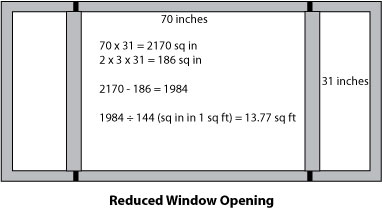
Here's the drawing with the new dimensions. These indicate the size of the glass.
The new window has 13.77 square feet of window opening. The pillars in the middle are each 3 inches wide compared to 1 inch for the originals, so we subtract a bit more there.
An inch here and an inch there reduced the window to 74% of its original size (13.77 ÷ 18.50). I think we can do better. We now (after breaking out the old windows) know the sills are level and straight, so we don't need so much extra space around the new window frame.
If we could get half the space back, what would it do to the opening?
73 x 33.5 = 2445.5 - 124 = 2321.5 ÷144 = 16.12 square feet or 87% of the originals.
Is 87 halfway between 100% and 74%? Yes.
You might wonder, What difference does a couple inches make in an existing window opening? It's still a window isn't it?
Here's a perfect time to use elementary school math to see the difference.
This photo shows the original window, from 1954 (sorry about the dirty dishes).
We will need the dimensions, so here they are on a drawing.
The old window was about 76 x 36 inches which works out to be 19 square feet of window area. I'm going to adjust for the center posts which are an inch wide (so each of them obstructs about 36 sq in of area). The total glass area is 18.5 square feet.
Here's a picture of the new window going in. You can see the gap around the top of the new window frame. It's difficult to remove the old steel window frames, so we left them in the walls. The decrease in size is measured from the old frame's inner edges, not from the opening in the wall.
Here's the drawing with the new dimensions. These indicate the size of the glass.
The new window has 13.77 square feet of window opening. The pillars in the middle are each 3 inches wide compared to 1 inch for the originals, so we subtract a bit more there.
An inch here and an inch there reduced the window to 74% of its original size (13.77 ÷ 18.50). I think we can do better. We now (after breaking out the old windows) know the sills are level and straight, so we don't need so much extra space around the new window frame.
If we could get half the space back, what would it do to the opening?
73 x 33.5 = 2445.5 - 124 = 2321.5 ÷144 = 16.12 square feet or 87% of the originals.
Is 87 halfway between 100% and 74%? Yes.
Monday, April 26, 2010
Please take this littoraly
Last week we reviewed a number of math words. Over the weekend I ran across another word that could have math implications - littoral.
The word first appeared in our newspaper because a new ship arrived in San Diego Bay, the USS Freedom. It's called an LCS (Littoral Combat Ship) and it's a 400-foot surface vessel intended for operation in the littoral zone (close to shore). Here it is:
The USS Freedom can sweep for mines, chase drug runners, fight off pirates, and rescue sailors in distress. It can cruise for 3500 nautical miles without refueling and reach speeds of 47 knots (52 mph)! That's why the front deck is so clean - otherwise everything would blow off.
The very next day I read about a community in Brittany (Northwestern France). The author said that oysters are a normal source of protein for "French living on the littoral."
How does math fit into oysters and Navy ships? Well, how wide is the littoral zone? How close to shore? Who determines what's close? Is it how close a 400-foot ship can get to shore? Well, like many things, it turns out to be a very complex subject.
Littoral could be as simple as being from the point of highest tide to the point of the lowest tide (although on a flat beach, that can be miles). Or it could be much farther out, especially if you don't want to be grounding your new ship in the mud. Luckily the USS Freedom's draft is only 13 feet.
Here's a Google map of our region's littoral zone. There are many underwater features; some of them are shown here.
The word first appeared in our newspaper because a new ship arrived in San Diego Bay, the USS Freedom. It's called an LCS (Littoral Combat Ship) and it's a 400-foot surface vessel intended for operation in the littoral zone (close to shore). Here it is:
The USS Freedom can sweep for mines, chase drug runners, fight off pirates, and rescue sailors in distress. It can cruise for 3500 nautical miles without refueling and reach speeds of 47 knots (52 mph)! That's why the front deck is so clean - otherwise everything would blow off.
The very next day I read about a community in Brittany (Northwestern France). The author said that oysters are a normal source of protein for "French living on the littoral."
How does math fit into oysters and Navy ships? Well, how wide is the littoral zone? How close to shore? Who determines what's close? Is it how close a 400-foot ship can get to shore? Well, like many things, it turns out to be a very complex subject.
Littoral could be as simple as being from the point of highest tide to the point of the lowest tide (although on a flat beach, that can be miles). Or it could be much farther out, especially if you don't want to be grounding your new ship in the mud. Luckily the USS Freedom's draft is only 13 feet.
Here's a Navy drawing of the littoral zone. They consider it to be from the high tide region out to where the water is about 200 feet deep. It includes the beach, the back shore, the foreshore, the shoreline, the nearshore, the offshore and so on. Marine biologists generally consider the littoral zone to be much narrower.
Here's an oyster. It lives in the inter-tidal and sub-tidal zones (both within the littoral zone), and is not happy about being disturbed by these big Navy ships.Here's a Google map of our region's littoral zone. There are many underwater features; some of them are shown here.
Friday, April 23, 2010
Inverted and Recurring Words
These math words popped up during yesterday's blog: Inverse [or Inverted] and Recur [or Recurring]. Let's invert the order and define Recur first, okay? (Is this a clever way to define inverse, or what?)
Recurring means continuing, on-going, repeating repeating repeating.
In math we could use it like this:
Give the value 2/3 in decimal form. Answer = .66666666 In this case, the 6 is a recurring number.
We could use it like this in a family:
Dave and Katy had a recurring argument over the size of Katy's mobile phone bill!
In her recurring dream, she would always have to give a speech to a large group of people ...
~~~~~~~~~~~~~~~~~~~~~~~~~~~~~~ ~~~~~~~~~~~~~~~~~~~~~~~~~~~~~~
Now let's get back to inverse. It means turn over; opposite; reverse, negative, "the other way".
Give the inverse of the fraction 2/3: Answer = 3/2 Another term for this is reciprocal.
Notice that the product [multiplicative inverse] of these two numbers is one. That means zero can't have a reciprocal, because 0 times a real number is 0, not 1.
Give the inverse of the real number -5: Answer = 5
Notice that the sum [additive inverse] of these two numbers is always zero.
This discussion has reminded me of two more words that we sometimes use in the math curriculum - most often describing coins. These are obverse and reverse.
Obverse means turned to face you. Reverse means turned to face the other way.
We would use it like this:
Which side of a coin is the obverse? The face or "heads" is always the obverse side. In the case of coins without a portrait (the Euro) the obverse is the common side, shared by all variations of the coin.
Which side of a coin is the reverse? The back side or "tails" is always called the reverse.
These photos show a Roman coin that my friend Ken located in a field in Dorset, England. He gives most of them to the farmers who own the fields, or to museums.
Recurring means continuing, on-going, repeating repeating repeating.
In math we could use it like this:
Give the value 2/3 in decimal form. Answer = .66666666 In this case, the 6 is a recurring number.
Dave and Katy had a recurring argument over the size of Katy's mobile phone bill!
Or like this:
In her recurring dream, she would always have to give a speech to a large group of people ...
~~~~~~~~~~~~~~~~~~~~~~~~~~~~~~ ~~~~~~~~~~~~~~~~~~~~~~~~~~~~~~
Now let's get back to inverse. It means turn over; opposite; reverse, negative, "the other way".
In math, we can use it like this:
Give the inverse of the fraction 2/3: Answer = 3/2 Another term for this is reciprocal.
Notice that the product [multiplicative inverse] of these two numbers is one. That means zero can't have a reciprocal, because 0 times a real number is 0, not 1.
Or we can use inverse like this:
Give the inverse of the real number -5: Answer = 5
Notice that the sum [additive inverse] of these two numbers is always zero.
This discussion has reminded me of two more words that we sometimes use in the math curriculum - most often describing coins. These are obverse and reverse.
Obverse means turned to face you. Reverse means turned to face the other way.
We would use it like this:
Which side of a coin is the obverse? The face or "heads" is always the obverse side. In the case of coins without a portrait (the Euro) the obverse is the common side, shared by all variations of the coin.
Which side of a coin is the reverse? The back side or "tails" is always called the reverse.
These photos show a Roman coin that my friend Ken located in a field in Dorset, England. He gives most of them to the farmers who own the fields, or to museums.
Subscribe to:
Posts (Atom)