Additional Math Pages & Resources

Tuesday, February 8, 2011

Math, Music and Wires

I confess that I did not like math in high school. In 11th grade I went to my counselor and asked for Auto Shop instead. She talked me into a compromise - Electronics Shop.

There in Mr. Valison's class I caught the tail end of vacuum tubes and the bleeding edge of solid state electronics. This was the best career-preparation move I ever made, as for the last 40 years I've put that electronics knowledge to good use (and discovered math is essential).

Today I present some wires. My wife says it's a mess, but this is after I spent a morning cleaning and straightening and bundling the wires, cables, fiber-optic pipes, and so on.

It's a typical household setup nowadays, with TV on top, a pull-out shelf filled with DVDs, a coaxial cable coming in from the antenna, a single DVD player, a Blu-Ray player, a 5-disc changer, an amplifier/control unit, Apple TV, cable modem, AT&T mobile phone hotspot transmitter, and a WiFi wireless router. Not to mention all the power connections, HDMI links and a Mac Mini with keyboard and mouse. [Click the photo to see more detail]

All the sound has to get to the speakers somehow, so I have wires running to the speakers in this room, and to my junction panel in the hall closet. I installed this panel 20 years ago when I bought this house, thinking it would be nice to keep the wires hidden. The sound comes in at the top, splits into right and left channels, then is routed through fuses and impedance-matching resistors to a junction block capable of serving 5 rooms. At the moment we are using 4 sets of speakers plus those in the TV room. [Click the photo to see more detail]
What does this have to do with elementary math as we teach in Excel Math? I'll list a few places where you need math in your home sound system:
  1. figuring out the monthly cost of all the services to which you are subscribing (cable, satellite, Netflix, Apple Store, etc etc)
  2. adding up the cost of all the hardware that you are buying 
  3. calculating resistance and impedance when you install so many speakers
  4. deciphering the frequencies that TV stations transmit so you can choose an antenna
  5. determining how much space you need to hold all the CDs, DVDs and videocassettes your family owns
  6. determining the disk storage you will need to hold all the digital files your family owns or will be buying
  7. calculating the length of the wiring to install the speakers around your room or house
  8. deciding which remote controls you need, and how to program them with the right numbers to cut down on the total pile of remotes on the shelf
  9. trying to figure out which addresses your network components are using (and violating), such as  192.168.1.1, etc.
  10. looking up part-time jobs on the web so you can earn extra cash to pay for all this junk
    If you didn't have training in this field, then you can use your math skills to figure out how much to pay one of the 20,000 Geek Squad technicians to come in and fix up your systems.

    Or you could just read a book, hopefully on math. Here's one.
    (And not on a Kindle or iPad, because that takes you back to Step 1, above.)

    Monday, February 7, 2011

    Math on Television

    I spent a couple hours on the floor this weekend, re-routing wires around the back of my television set and sound system. In the process of doing this, I rediscovered a few secrets about TV screen sizes.

    (Go here to refresh your mind on measuring screens)

    Our old TV was a Sony WEGA 32" tube-type model. Here's an old photo of it, in its cabinet. The screen is 32 inches diagonally. It has a 4:3 ratio of width to height. What are the screen's dimensions?

    I forgot to measure it before I gave the TV away, but given this information, we can figure it out. That's what math is for, right?


    Our latest TV (which we got from a friend) is a 40" Sony Bravia. That means 40 inches diagonally. It has a 16:9 ratio of width to height. It's much wider so I had to cut the top of my TV stand.

    What are the screen's dimensions? I could measure the TV when I get home today, but that's no fun. Let's calculate its size too.

    You learned in elementary school (using Excel Math, I hope!) that the length of the diagonal c (the hypotenuse) of a triangle is related to the other two sides of the triangle. The formula that describes their relationship is called the Pythagorean Theorem and in layman's terms is stated this way:

    a2 + b2 = c2.

    We need this formula for our calculations. Here's my work on calculating the dimensions of the first Sony TV:


    It is 32 inches diagonally and it has an a/b ratio of 4:3. Diagonal c = 32 and c2 is 1024.

    I now need to find numbers for a and b where two things are true at the same time:

     a2 + b2 = 1024 and simultaneously 3a = 4b

    If you look at my work on the whiteboard, you will see I came up with a = 25.6 and b = 19.2

    I did this by trial and error - I just chose some dimensions and calculated until I found the right answers. Now on to the new set. We use the same process.


    It is 40 inches in diagonally, and has an a/b ratio of 16:9. Diagonal c = 32 and c2 is 1600.

    I now need to find numbers for a and b where two things are true at the same time.

    a2 + b2 = 1600 and at the same time 9a = 16b

    If you look at my work on the whiteboard, you will see I came up with a = 34.85 and b = 19.6

    Let me explain in more detail. I did this by trial and error - I just chose some dimensions and calculated until I found the right answers. You can do it too, there's no fancy math here:

    1. choose a number a , say 35 and multiply it by itself (square it) a= 35 x 35 = 1225
    2. check to make sure that's smaller than c2 or 1600. It is.
    3. multiply a by 9 to get 315, then divide 315 by 16 to get b = 19.7 (this is to ensure the dimensions match the 16:9 ratio of our set)
    4. multiply 19.7 x 19.7 (square it) to learn that b2 =388
    5. add 388 and 1225  and get 1613 - is this sum equal to 1600 or c2 ? No, it's too large.
    6. start over with a smaller a, such as 34.9 and see what happens.

    The numbers in red on each screen represent the square inches of screen area or a x b.

    You can see the new TV is larger than the old one. But how much larger? How would you calculate the difference?

    You might do it this way 40 inches divided by 32 inches = 1.25 times larger diagonally.

    You might do it this way 683 divided by 492 = about 1.4 times larger in surface area.

    Same TV sets, same math, almost-but-not-quite-the-same question = different answers.

    (I'm home. I measured. The calculations were correct!)

    Friday, February 4, 2011

    Hair today, gone tomorrow Part III

    We seem to cover the strangest things in this blog, while attempting to show how math is used in everyday life. This series on hair has come around to the question of what is a haircut? and Who can give you a haircut?
    It would seem (to a man) that a haircut is when a barber cuts some of your hairs shorter, using a sharp tool. But most people want more than just cutting. We really want to look better, and cutting hair is only one part of an attractive appearance.
    The term barber faded. Hair stylist came to mean a much cooler person who doesn't just cut hair. What is a hair stylist then?  This is best answered by referring to legal definitions. When the lawyers and the government get involved, it becomes complicated! Here's what California has to say on the subject, at its Barber/Cosmetologist website
    • A barber can prep, style, cut, color and shave hair, and can apply cosmetic preparations, antiseptics, powders or lotions to the scalp, face or neck. Barbers are the only ones who can shave a consumer or display a striped pole outside their shop.
    • A cosmetologist can prep, style, cut, color, bleach or straighten body hair, including tinting eyelashes; may give facials and remove hair by waxing or tweezing. The license allows them to provide any services of an esthetician or manicurist (see below)
      • Estheticians can perform facials and remove body hair by tweezing or waxing. They may apply makeup, false eyelashes, and do face or neck massages. They can bleach skin using chemical exfoliation.
      • Manicurists can give manicures and pedicures and apply gel, acrylic or silk false nails. They are limited to working on hand and foot areas only. Ingrown toenails must be treated by a doctor.
    • Electrologists may use a needle or probe to remove hair from a person using electric current. They are the only licensees that can use needles. 
    • Wigologists are people trained in wig and hairpiece fitting, styling, coloring and repair.
    • Physicians (and nurses working with them) can do laser hair removal or aesethetic cosmetic (plastic) surgery.
    Services provided in the following areas do not require certification from the state as barbers or cosmetologists, although they might need other training or licensing:
     
    • Hairbraiders create elaborate braids and cornrows in naturally curly hair. Braiding is specifically exempted from cosmetology licensing in California and some other states. 
    • Massage Therapists who treat muscles beyond the face and neck.
    • Practitioners who apply permanent makeup, cosmetics or tattoos.
    • Operators of tanning salons.
    Having said all that, here is some information from the Bureau of Labor Statistics. If you want to consider hair styling as an occupation in the next decade, we're going to need almost a quarter-million more than we have today.

    Occupation2008
    in 000s
    2018
    in 000s
    New Jobs
    in 000s
    New Jobs
    in %
    % Self
    employed
    Openings
    in 000s
    Annual
    Earnings
    Barbers5460 6 11.6 80.6 14.0 $24,050
    Cosmetologists 631758 127 20.1 43.5 220 $23,140
    Teachers 750860 110 14.7 20.8 226 $31,100
    Mathematicians 33.6 0.7 22.5 0.0 1.5 $95,150

    However, if you want to earn lots of money, you could take up math. Notice there aren't many mathematicians, and none of them are self-employed. Although they make a lot of money, they certainly don't make anyone else look better. Except perhaps by comparison.

    Thursday, February 3, 2011

    Hair today, gone tomorrow Part II

    Today I will focus on math related to the hair on our heads.

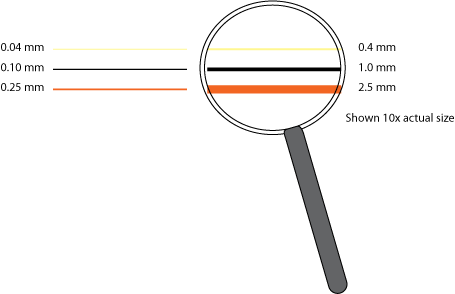
    No doubt you have heard the phrase "as thin as a human hair". How thin is that?

    It depends on your ethnic origin. Hair thickness ranges from .04 to .25 mm - on average it's about one-tenth of a millimeter or .1 mm. [Click for a larger image]
    Thicker hair emerges from large hair follicles - thickest tend to be red/orange and dark or black hair. Finer hair comes out of smaller follicles and tends to be lighter or blonde. We don't know for sure if this is genetic.

    Of course we've been talking about a hair from the top of your head. If you haven't already noticed, ear hairs, nose hairs, moustache and beard hairs can be much thicker.

    Our hair follicles have a self-regulation function that determines how long their hairs should be. Eventually hairs stop growing, fall out, and a new hair emerges. But not always. Sometimes it keeps growing.

    Here's a young lady named Xia Aifeng, in China. Her hair is 2.75 m (9 ft) long. You can search for her on YouTube and watch her washing, combing and throwing her hair around.

    As we get older, the regulation system may stop working on a few of your follicles too. That's why some older people have long ear and nose hairs. How long? I checked at the Guinness World Records site:
    • Toshie Kawakami in Japan has one eyebrow hair 17.8 cm (7.0 in) long
    • Anthony Victor in India has ear hairs 18.1 cm (7.1 in) long
    • Richard Condo in the USA has chest hairs 22.8 cm (9.0 in) long!
    If this seems gross, just wait. It could happen to you!

    Notice that so far we are only talking technical details about our existing hair(s), with nothing said about removal, hair styling and coloring, or hair loss. Those are subjects full of math as well as emotional risk! Maybe something for another blog...

    If you are interested in more details about your hair, you might want to visit the Hairfactz site.

    As for me, I'm going to have lunch and go get my hair(s) cut.

    Wednesday, February 2, 2011

    Hair today, gone tomorrow Part I

    Let's apply math to the hairs that plague us. We have hair on our heads, hair on various other parts of our bodies, and hair on our furniture from our pets.

    I have read that the average person has about 5 million hairs on his or her body. Of those, perhaps 100,000 or so are on top of our heads. We are born with all the hair follicles (roots) that we will ever have. In fact, some babies are born hairy, with what are called lanugo hairs, but those quickly turn into vellus hairs or terminal hairs. Here's a very hairy baby related to one of our employees ...


    Hair grows all the time, and falls out when it has done its duty. Although all of us (people) shed hair, it isn't that big a deal unless it ends up clogging the drain in the shower.

    When we go bald we don't really stop growing hairs, the terminal hairs from those particular follicles just become ever so much finer and nearly invisible - they become vellus hairs. Most people have more-or-less visible terminal hair in various places, but invisible vellus hair elsewhere. Our skin is not completely hidden, thus we don't call our hairs fur, or a coat.

    Why am I writing about hair and fur and coats? A convergence of hair-related activities, I guess. It's time for me to get my hair cut, AND I got a nifty advertising email from Dyson about a dog vacuuming attachment. This might turn into a best-selling item for them, as many dogs shed hair all over the place.  So today we will talk about pet hair/fur.

    I only had one question for Dyson - Does it work on cats? Sadly, No. They say this new item is not good for cats. I can say from experience that vacuums and my cats don't get along. Although Tiger III looks cute here, that doesn't mean he won't bite me if I come near him with the vacuum!


    Cats and dogs, along with many other mammals have what we call fur - dense hair all over their bodies. This fur may also be referred to as their coat. Cats have various types of hair, such as whiskers, guard hairs, down (undercoat), vellus (fine hairs), awn hairs, etc. You can see all those types of hair in the picture of Tiger's face.


    The color of cat fur is determined by its genetic makeup. My cat's hair color is called red tabby. Did you notice how close his hair color is to the golden retriever in the Dyson ad? Here he is (above Tiger is on the left) with his friend Boomer from across the street (below Tiger is on the right). They look amazingly alike in size and coloration but came from different litters in different cities, so we are sure they are not related.


    Here's one of our previous cats having a nap. We called him Tiger II. Yes he's enormous in this photo but he was 21 years old then, so his weight didn't seem to shorten his lifespan any.


    I don't have pictures of Tiger I but he was also the same color. As for why we have had 3 cats of exactly the same coloration for a total (so far) of 32 years I can't say. We did have a completely black cat too, named Panther. Here she is giving me the "I can't be bothered with you" look.


    Cat fur coloration is a complex topic and there's plenty of math in it! Sadly I have used up all my time showing you pictures of my pets, so you have to go elsewhere to learn more about the names for colors and to learn about the genetics behind coloration. And here's a site with an interactive tool so you can see what possible colors might come out of a litter (assuming you know the father and mother).

    Tomorrow we'll cover more hair math.

    Tuesday, February 1, 2011

    Easy-Hard, Easy-Harder, Easy-Hardest, Easy

    Wah! I wrote 99% of today's blog and it inadvertently got erased. So now I have to start over, which normally means you get a better, more pleasing (shorter) blog.

    Today I will explain some of the features of a typical Excel Math lesson. Here are both sides of a typical Lesson Sheet, for your viewing pleasure [click for a larger view].


    After much tedious reading of research papers, I'd like to summarize three very important techniques we use to help students learn math.
    • Interspersal
    Students can improve accuracy and have a more positive attitude when we mix simple problems in the midst of a bunch of complicated ones. Research shows students are more motivated to complete their lessons when there are a few very easy calculations among the difficult items. Click here.
    • Explicit Timing
    Explicit timing involves setting a time interval for completion of an assignment, and then announcing time as it passes - "You've used 10 minutes; you have 5 minutes to go."  Explicit timing and interspersal assignments have been proven to enhance student math practice. When interspersal assignments with explicit timing were compared to interspersal assignments without timing, it was found that explicit timing raises achievement, but students did not maintain the higher work levels for long. The second phase of this study added rewards and set academic targets for students, but neither of these approaches reliably increased performance. Click here.
    • Incremental Rehearsal
    Incremental rehearsal helps students build capability in math, by injecting new or novel problems into a continually-growing base of known items. The likelihood that a student will tackle the new difficult work is raised due to on-going success at solving familiar problems. What is not clear yet is the optimum ratio of known-to-unknown items (researchers have tested ratios ranging from 90-10% to 50-50%). In general, more unknown items (50-50%) mean students learn more in the short term. More known items (90-10%) mean students have better retention over the long term. Click here.

    Excel Math uses both interspersal and incremental rehearsal approaches. In additional to our year-long spiraling approach to individual objectives, we also provide the Checkanswer which does two things: it allows students to check their own work, and the simple 3-4 item addition problem provides some respite from the challenging problems on the rest of the page.

    The teacher can employ explicit timing whenever appropriate, especially on the Guided Practice part of the lesson.

    NOTE: If you want to read more, click the links at the end of each paragraph, or search on the specific term to find the research papers that interest you most.

    And that's enough for today.