Additional Math Pages & Resources

Monday, August 8, 2011

Second Anniversary Math

Hello and welcome to the Excel Math blog. We started writing two years ago, this week. Click here to see the first posting. Our goals for the blog are to:
  • increase exposure of our Excel Math curriculum, created long before Microsoft Excel came along
  • demonstrate how the math concepts we (or our kids) learn in elementary school can be interesting AND useful in daily life
Today I'm looking at some of the numbers generated in pursuit of these two goals.

THE BLOG

I've written virtually every working day - creating 488 posts. Using division, that's 488/2 = 244 per year. I could have reached 500 if I hadn't taken some vacation along the way. So using multiplication, it's 50 weeks x 5 posts/week

Blogger (the software I use) is provided by Google. Most of the blog's graphics and audio are stored on the Google' s Picasa site. The Picasa meter says I've uploaded 2227 images that occupy 145 mb. As a percentage, that's 14.2% of my total free space.

Some media files are duplicates (due to editing and changes). My estimate is about 2000 images are linked from the actual blog posts. Using division and rounding, we learn 2000/488 = 4.1 images per posting.

EXPOSURE
If my first goal is to gain exposure, how am I doing?

Compared to the megasites, not too well. Here are the top ten, hits-wise:
  1. Google (search, mail, etc.) 
  2. Facebook (social networking) 
  3. Yahoo (community & mail)
  4. YouTube (videos)
  5. Wikipedia (encyclopedia) 
  6. MSN (news)
  7. Amazon (commerce)
  8. eBay (auction & commercial)
  9. Twitter (social network)
  10. Bing (search)
Considering this Excelmath blog subjest is elementary school MATH, not a new dress or video of a Frisbee-catching dog, it's doing just fine. My site monitoring meters say we've had 49,000-51,000 unique visitors. Using division, 50,000/24 = 2083 or about 2,100 a month.

We've had visitors from 170 countries.

The largest number of unique, first-time visitors was 251 on calendar date March 3, 2011. (Evaluating paper towels, in case you are interested - click here).

Large numbers are part of a concept called number sense. Getting many hits on a blog is not that hard - you just write about fast cars, pretty women, your pets, getting rich quick, and the secret lives of Hollywood celebrities. But those subjects don't have much to do with elementary math.

DEMONSTRATION
The readers of the blog have to be the ones to judge the utility of the site. But I can say from my point of view, that it's been extremely interesting, plenty of hard work, and lots of fun as well. Here's one of my favorites.

If you want to read some of the past postings, you have two choices -  you can search using Google for Excelmathmike (all one word) or you can use the drop-down box in the left margin and select the posts chronologically.

CONCLUSION
I'm on vacation this week, but I didn't want to miss this anniversary posting. Time for me to go relax in the sunshine with my cat - who doesn't care about appearing in our blog to gain me more readers! But here he is anyway.


Friday, August 5, 2011

Superlative Math

Yesterday I used the term superlative when speaking of the last 3 blog posts. When I said it, I meant we were examining objects at the extreme ends of a spectrum (longest, tallest, quietest, etc.). The whole idea of comparing multiple items is a fundamental part of MATH. Even our Kindergarten Excel Math elementary curriculum starts out with comparison words.

This morning I started researching the concept of superlative:

DEFINITION: the highest degree attainable, meaning of the highest kind or quality; surpassing all others; supreme, extreme

ORIGIN: The word came into English from Latin, via Olde French, about 625 years ago.

PRONUNCIATION: soop'erluhtiv 

HYPHENATION:  su-per-la-tive  with 11 letters and 4 syllables

SYNONYMS: acme, height, elevation, peak, pinnacle, summit, top

SLANG SYNONYMS: A-OK, awesome, boss, cool, fab, fantabulous, gangbusters, groovy, numero uno, No. 1, out of sight, phat, prize-winning, rad, righteous, sick, top-notch, unsurpassed, wizard

As you may know, the superlative describes a part of our grammar. Sometimes it's hard to understand (our own) grammar, so I went over and did a lesson on superlatives at Study Spanish.com. Here's a snippet:

GRAMMATICAL:
We use superlatives to compare things. There are two types of superlative: relative and absolute.
Relative: John is the smartest boy in the class.
Absolute: John is very smart.
The relative superlative describes a noun within the context of a group of 3 or more things:
John is the smartest boy in the class; or Of the three, Manny is the meanest.
The absolute superlative describes a noun that is not in the context of a group:
John is very smart; The book is extremely expensive
In English, a relative superlative is formed by using the word "most" or the ending "-est."
Jose is the most intelligent boy in the class; Maria is the smartest girl in the class.
In Spanish, a relative superlative combines an article with mas or menos then adds an adjective and de
Juan es el chico más inteligente de la clase; John is the smartest boy in the class.
Bill Gates es el hombre más rico de los EEUU; Bill Gates is the richest man in the US
In Spanish, an absolute superlative may be formed in one of 3 ways - muy and adjective or sumamente and adjective or adjective and ísimo. Each of these is a little stronger than the preceding one; so -ísimo means a superlative superlative!
muy guapo; very handsome
sumamente guapo; extremely handsome
guapísimo; indescribably handsome
EXAMPLE:
Since this is a MATH blog, I'd better end with some numbers, right? Here is a superlative table of astronomical data.

Unit of ComparisonEarthMarsJupiterSuperlative sentence
Planet Diameter (km)12,7606,790142,800Jupiter is biggest.
Distance from Sun (million km)150228778Jupiter is most distant from the Sun.
Length of day (hours)242510Jupiter has the shortest day.
Number of Moons1216Jupiter has the most moons.
Surface Temp. (°Celsius)22-23-150Jupiter is coldest.

Thursday, August 4, 2011

Quietest Places on Earth?

Monday we saw the longest truck in America. Yesterday the tallest building in the world. Today in this series of blogs about superlatives, I'd like to investigate the quietest places on earth. I'll try to mention numbers and concepts you might need for quietness. Can elementary school math (as taught in our Excel Math curriculum) help us comprehend a lack of noise?

Noise is measured in decibels. As with the temperature 0 degrees, 0 decibels is not equal to NO NOISE at all. It is equal to the lowest level of sound that people can commonly hear. Instruments (and some animals) are capable of hearing sounds that we cannot.

Sound is a bit like water - it fills all the available space, it bounces around in waves, it can be deflected by a hard surface or absorbed by a spongy surface.

I took a little survey to see what people think is the quietest place on earth:
  • My wife said the quietest place must be Carlsbad Caverns. One visitor said, "This is everyone's idea of what a cave SHOULD be: quiet, clean, dry, flat, full of fantastic formations, high ceilings, and good lighting." The contractors at the site say they ensure "Soundscape protection" by using low-noise equipment, turning all equipment off at night, and using decibel meters to monitor, measure and reduce noise impact. On the other hand, their "janitors" use special vacuum cleaners at night to remove lint from the formations next to the trail!

    • Friend A suggested Mount Whitney, at 14,505 feet elevation. Maybe, but it depends when you go. Besides the wind and the occasional aircraft, the Forest Service reports 30,000 hikers and climbers a year go to the top, and 200,000 pass through the Whitney portal, mostly in the summer - so 1500-2500 cars a day are squeezing into 300 parking places.

    • Friend B choose Antarctica. Although it is windy, and only 4000 scientists (with some of their kids) live there, it's still free of most noises. Underwater is another story. I learned about multiple sound tests near the Antarctic: blasting up to 205 decibels in Acoustic Thermometry experiments; low- and mid-frequency active sonar research with naval vessels; seismic surveys, dredging and construction; offshore wind farms, and science experiments. Go here and click on Explore to hear underwater sounds. [click on the map to enlarge it]

    • Friend C chose the Grand Canyon in Arizona, but what about the tourists flightseeing? The latest proposed noise controls still permit 364 flights a day or 65,000 flights a year over (but not within the walls) of the Canyon. This is a complex issue - we want people to enjoy the natural resources but doing so in a plane or helicopter shouldn't spoil the day for those on foot. [click on the map to enlarge it]

      • I like Anza-Borrego State Park, where 600,000 acres are protected. Although off-road vehicles are allowed in certain areas of the park, and a few planes fly overhead, it's very isolated. In the Badlands, even the terrain seems specially-constructed to absorb sound.


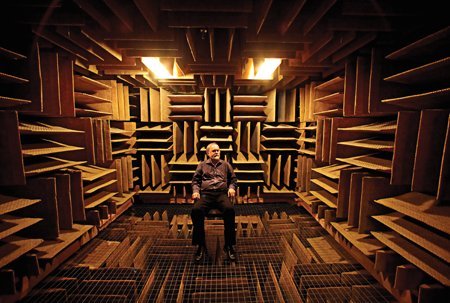
      I turns out we were all wrong. Have you heard about anechoic chambers? Places specifically constructed to keep noise out?

      The quietest place on earth is inside the Orfield Anechoic Chamber, up in Minnesota. (Only about 25 miles from the Road Train factory!)


      Orfield Labs has a room inside a larger room, both contained within a third room. The inner-most anechoic space is a 6-sided steel box floating on springs, inside a larger 5-sided steel box, again spring-mounted on steel beams. These chambers are within a larger room with 1-foot-thick concrete walls and ceilings. The smallest room is filled with 3.3 feet thick fiberglass acoustic wedges as shown in the photo. This inner chamber was measured at negative 9.4 dB (the lower limit for human hearing is 0 dB).

      Wednesday, August 3, 2011

      In the sky with diamonds

      Yesterday in the Excel Math blog I introduced the 400-foot-long  Perkins Road Train. It's the longest US road vehicle ever, and is currently moving a 3/4 of a million pound boiler from San Diego to Utah.

      Today we'll look at the recently-announced, kilometer-tall Kingdom Tower. I've spent a long time today gathering data that has been reported about this project. Here are some of the numbers that our elementary math students will understand, WHEN they learn the underlying concepts taught in our curriculum [the concepts are shown below in brackets like this].

      THE DEAL
      • HRH Prince Alwaleed bin Talal is building the tower; his assets are worth about 20 billion dollars [money]
      • The Prince may be the 20th richest person in the world [ordinal numbers]
      • The proposed tower would be the tallest in the world [comparative value words]
      • The tower is expected to take 63 months (about 5 years) to build [time, calendar, months and years]
      • The cost of the tower will be 4.6 billion riyal, which is US $1.23 billion, while the value of the land is 8.8 billion riyal, which is about US $2.5 billion[foreign exchange conversion; decimal numbers; money]
      • The prince's company and another firm will each have a 33% or 1/3rd interest while the contractors and another man will each take a 16% or 1/6th interest in ownership of the tower [percentages; fractions of the whole
      • Adrian Smith, the principal architect, tells us why we don't have the world's biggest towers in the United States: "tall buildings are a catalyst for developing the land around them ... the person who owns the tall buildings and the land around them will make his money off the land. The tower gives the land prestige, location and identity. One of the problems in the United States is that most super-tall buildings are in the inner city. You just can’t get that much land in the U.S. because we’re not really developing new cities."


      THE TOWER
      • The floor area of the inside of the tower will be  at least 5.7 million square feet [concept of area]
      • The tower will be at least 1000 meters (3281 feet) tall, or described in larger units, 1 kilometer (.62 miles) [distance; height; metric units; conversion]
      • The base of the tower will be about 2 square miles although it will be a triangular shape, not square [geometric shapes; area]
      • A ride to the top in one of the 59 elevators would take at least 4 minutes, if an elevator rises 1000 feet per minute [combination units; feet per minute; estimating]
      • The observation deck elevators will travel at 10 meters per second so the ride to the top will take 100 seconds, or 1.6 minutes! [metric units of velocity, time conversion]
      THE LOCATION
      • The tower will be located very close to sea level [elevation
      • The tower will be in the center of the 23-hectare (55 acre) Waterfront District [area; metric conversion]
      • The tower will be located north of the city of Jeddah, whose 4 million residents live close to the Red Sea. [large numbers ]
      • The building site's latitude and longitude are 21.733°N and 39.090°E [maps; navigation]
      MORE DETAILS

        Tuesday, August 2, 2011

        'till the wheels fall off

        Today in our Excel Math blog I'm going to take you on a trip back in your memory, AND throw a few big numbers at you, just for practice.

        Remember the hook-and-ladder firetruck? So long that you needed someone in back to steer it around corners? (Raise your hand if you always wanted to be that person driving the back end!)


        Well, this past Saturday my wife and I drove to Los Angeles and back. In San Celemente, we saw the largest, longest, wheel-iest tractor-trailer rig ever! It's a hydraulic platform trailer from Perkins Specialized Transportation in Northfield, Minnesota.

        Perkins Road Train in Oceanside, CA

        The trailer's components were hauled out here to Southern California by 9 separate trucks, then reassembled and tested. This week it's moving a 758,000-pound generator 900 miles to Clive, Utah. Once the generator is off-loaded, the trailer will be disassembled, brought back to San Diego, and reassembled to make more trips. There are 4 of these steam generators going off into storage.


        This unit features 192 tires and 48 axles - all of them able to be steered by a Bluetooth remote control. The trailer is 399.6 feet long, 20 feet wide and weighs 1.4 million pounds, loaded. It's moved by five giant 600 hp tractors - 1 pulling and 4 pushing when needed. Top speed is about 20-25 mph. They only drive at night, to avoid having problems with traffic.


        Perkins spent 2.5 years designing and building this monster load carrier - which clearly outranks the fire truck for coolness!

        If you'd like to download a 3-pg Perkins flyer explaining the Road Train, you can click here.

        This is a short video of the Perkins guys practicing turns with their trailer.

        Monday, August 1, 2011

        Balancing our Budget

        I've been posting on how we teach kids about math and money. For many reasons, we try to help them understand that spending less than what you have is the best long-term financial strategy.

        Of course, that isn't the case in all situations,. We sometimes borrow money, to (1) buy a house, (2) buy a car, (3) pay for college, etc. In the government, we borrow for major events too - building highways, paying for wars, starting off new programs before the taxes roll in, etc.

        Today our federal government is finally getting around passing a bill to balance its budget.

        Go here to download a copy of the proposal.

        If you are not a financial news analyst, you'll probably be letting someone else read it. In fact, I skimmed through its 74 pages for you, and have this to report:
        • There aren't any pictures!
        • There are lots of big words - such as sequestration
          • a. to renounce or disclaim, as when a widow appears in court and disclaims any interest in her deceased husband's estate; she is said to sequester
          • b. to take something controversial out of the possession of contending parties and deposit it in the hands of a third person; this neutral party is called a sequestor;  
          • c. denotes the act of seizing property by court order;  
          • d. the isolation of a jury from the public, or the separation of witnesses to ensure the integrity of testimony.
        • There are plenty of tricky math and money problems in the proposed law:   
          • "reduced by a dollar amount calculated by multiplying the enacted level of non-exempt budgetary resources in that account, at that time, by the uniform percentage necessary to offset the total dollar amount by which outlays are not reduced in military personnel accounts"
        • There are calculations requiring careful clockwork:
          • Two hours of debate, equally divided and controlled by the proponent and an opponent ... all debatable motions and appeals shall be limited to not more than 20 hours, which shall be divided equally between the majority and minority leaders ... any single debatable motion or appeal may not exceed 1 hour, divided equally between those favoring and those opposing. All time used for consideration of the joint resolution, including time for quorum calls and voting, shall be counted against the total 20 hours.
        • There are fancy calendar calculations too:
          • Not later than 7 calendar days (excluding Saturdays, Sundays, and legal holidays) after the date of enactment of any discretionary appropriation ... outlays for the current year, if any, and the budget year, and each outyear ... shall equal the baseline levels of new  budget authority and outlays using up-to-date concepts and definitions, minus those levels using the concepts and definitions in effect before such changes.
            • The term ‘Outyear’ means a fiscal year one or more years after budget year; that is, further away in the future
        • We have adjustments for "emergencies", based on history:
          • DISASTER FUNDING - if during 2012 through 2021, appropriations for disaster relief [are made by Congress] the fiscal year [budget] shall be adjusted but the total is not to exceed the average funding provided for disaster relief over the previous 10 years, excluding the highest and lowest years.
            • The term ‘emergency’ means a situation that: 
            • a. requires new budget authority and outlays flowing therefrom, for the prevention or mitigation of, or response to, loss of life or property, or a threat to national security; and this emergency is unanticipated, ie
            • b. sudden, which means quickly coming into being or not building up over time
            • c. urgent, which means a pressing and compelling need requiring immediate action
            • d. unforeseen, which means not predicted or anticipated as an emerging need
            • e. temporary, which means not of a permanent duration
        • It's not very interesting reading, but it takes lots of concentration to follow:
          • Unless a joint committee bill achieving an amount greater than $1,200,000,000,000 in deficit reduction as provided in section 401(b)(3)(B)(i)(II) of the Budget Control Act of 2011 is enacted by January 15, 2012, the discretionary spending limits listed in section 251(c) shall be reduced ... {with} half of the total reduction calculated pursuant to paragraph (3) for that year to discretionary appropriations and direct spending accounts within function 050 (defense function) and half to accounts in all other functions (nondefense functions).
        •  Finally, there are goals and aspirations, turned into law:
          • Effective on the date of enactment of this section, for the purpose of enforcing section 201, the Chairman of the Senate Committee on the Budget shall reduce any balances of direct spending and revenues for any fiscal year to 0 (zero).
        Wouldn't seem easier to say "spend less than you take in?" That's what my grandfather told me when I was a kid, and I understood what he meant even then.