Additional Math Pages & Resources

Wednesday, March 2, 2016

National Anthem Day: Coins, Presidents & Song


On March 3, 1931 (85 years ago), “The Star Spangled Banner” become our national anthem.

National Anthem Day is celebrated on March 3rd of each year in remembrance of this occasion.

“The Star-Spangled Banner” is the national anthem of the United States of America.

The lyrics come from “Defence of Fort McHenry”, a poem written in 1814 by Francis Scott Key, after witnessing the bombardment of Fort McHenry by the British Royal Navy ships in Chesapeake Bay during the Battle of Fort McHenry in the War of 1812.

At the time, Francis Scott Key was a 35-year-old lawyer and amateur poet.

The poem was set to the tune of a popular British drinking song, written by John Stafford Smith for the Anacreontic Society, a men’s social club in London. “The Anacreontic Song” (or “To Anacreon in Heaven”), with various lyrics, was already popular in the United States. 

Set to Key’s poem and renamed “The Star-Spangled Banner”, it would soon become a well-known American patriotic song. With a range of one and a half octaves, it is known for being difficult to sing.

Although the song has four stanzas, only the first is commonly sung today, with the fourth (“O! thus be it ever when free men shall stand…”) added on more formal occasions. You can see the verses in red, white and blue, creating the flag at the top of this post.

“The Star-Spangled Banner” was recognized for official use by the Navy in 1889 and the President in 1916, and was made the national anthem by a congressional resolution on March 3, 1931 (46 Stat. 1508, codified at 36 U.S.C. § 301), which was signed by President Herbert Hoover.

The fourth stanza includes the line “And this be our motto: In God is our Trust.” The United States adopted “In God We Trust” as its national motto in 1956. This motto is included on the head side of our coins.

If your students need help identifying coins and U. S. Presidents, try the presidents game at U.S. Mint.gov for a fun way to practice. Several presidential coins or portraits are pictured along with related questions. Your students answer questions such as, "This president was elected in 1960." Students drag the correct coin or portrait into a box to answer each question.

Excel Math lessons give students lots of practice learning coins, counting money, working with decimals, and much more. Take a look at sample lessons on our website: http://www.excelmath.com/
and visit our web store to place an order: https://excelmath.myshopify.com/

You may also like these articles:


Monday, February 29, 2016

Leap Year Math

Perhaps you've heard that this year 2016 is a leap year. How do we know that?

We use the figure 365 for the number of days in a year.

In actuality, the number is closer to 365.25. To compensate for this discrepancy, every four years we have what is called leap year.

In leap years, a day is added to February. Normally February has 28 days.

However, every 4 years, we give February 29 days to  help synchronize the calendar year with the solar year, or the length of time it takes the earth to complete its orbit about the sun,  about 365.25 days.

A leap year has 366 days. The year 2016 is a leap year with 366 days. So the month of February will have 29 days.

Because 365.25 is not exact, three leap years are dropped every 400 years.

These are the end-of-century years that are not evenly divisible by 400.

These rules only apply to the Gregorian calendar currently used by American and European countries.

Several other calendars are used by Asian countries.

Here's a formula we can use to find out if a year will be a Leap Year:

Leap Years are any year that can be evenly divided by 4 (such as 2012, 2016, etc.)


   except if it can can be evenly divided by 100, then it may not be (such as 2100, 2200, etc.)


   except if it can be evenly divided by 400, then it is (such as 2000, 2400, etc.)

In other words:
1. Divide the year by 4. If there is no remainder (so it divides evenly), it may be a leap year.
2. Divide the year by 100. If there is no remainder, then it may NOT be a leap year.
3. Divide the year again, by 400. If there is no remainder, it is a leap year.

Both 1600 and 1700 are evenly divisible by 4. However, 1700 was not a leap year because 1700 is not evenly divisible by 400.

Can you determine which of these years were leap years? The answers appear below.

             1960            1930             1836              1862

You may also like these articles:


Answers:
1960 and 1836 are both divisible by 4 and 400. 1960 is also divisible by 100. So both 1960 and 1836 are leap years.

Monday, February 22, 2016

Teacher of the Year: What's her secret?

Susan Vilar credits Excel Math with helping her achieve Teacher of the Year at Hoover Elementary School in Oklahoma. 
We are proud to partner with Susan and dedicated teachers just like her around the country. 
Excel Math opened the door to Susan's students, giving them the tools to be successful with math and providing them with some of the best elementary math lessons available today.

"I was nominated and won Teacher of the Year for my school campus, Hoover Elementary."  Susan told us. "I completely believe this happened because of the EXCELlent Math program you provide!!! Thank you so very much!! I've used Excel Math for many years … and loved it! I started using Excel Math in Texas with excellent test results. Each year produced 95% to 100% of the students passing their Texas State Tests. I’m currently in Oklahoma, and I’m VERY excited to use this program again with my 4th graders. I can’t wait to compare the scores from last school year to this."
Thanks, Susan! We appreciate the great comments and the way you are building success in math among your students.
Beginning a new math program in the middle of the year can be a challenge! 
If you're getting started with Excel Math mid year, here are some strategies to help you get off to a flying start. Take these steps to build student success mid year:
1. Use the Excel Math Placement Tests
Excel Math provides FREE Placement Tests to help you determine where your students should begin in math. Each Excel Math Placement Test file contains six tests that evaluate a student's preparedness for Excel Math.

The tests are labeled A - F, which correspond to first through sixth grade. Instructions for using the tests are included. Save the test to your computer and print it for each student. 

Download the test (in English or Spanish) from our web store: excelmath.myshopify.com


You may also like these articles:


Tuesday, February 9, 2016

Celebrating e-Week in the Math Classroom

Although it may not be as well known as Pi, e is also an irrational number that is roughly equivalent to 2.7.

The first few digits are: 2.7182818284590452353602874713527. It's decimal expansion never terminates.

So the week of February 7 is the logical time to celebrate e in all its variations.

Your students may have used e in exponential and logarithmic functions.

It is an expression that is used in the study of compound interest. It is often called Euler's number after Leonhard Euler, who proved that e is an irrational number.

The number e is a mathematical constant.

Let your class have fun celebrating e-Week with egg-shaped candy, enchiladas, edible snacks, effervescent drinks, etc. 


You may want to have your students read the poetry of ee cummings or Edgar Allen Poe, watch a clip from the E! Network or ESPN, read an e-book, do some of their work on electronic devices, listen to music with earbuds, do some math problems that use e or 8 or any number that begins with "e."

Let your students email a math problem to a classmate, create an elaborate story problem, do some Excel Math Stretches (brainteasers from your Teacher Edition), or do anything else you can think of that relates to e!

Your students could find the dimensions of the Eiffel Tower, use an encyclopedia (electronic or hard copy), discover some fun math facts about the earth or England, play a game of crazy eights, dress up in clothes from the 80s, and find cookie recipes with and without eggs.

Then let your students write as many math problems as they can with the numbers 8, 11, 80 - 89, or any numbers that contain the letter "e".

Challenge them to solve problems with exponents, add a list of eight (or eleven) numbers and then do it again keeping track of their best time.

Have your students write a note of encouragement to one of their favorite teachers or to their parents. Use the comment box below to share your e-Week activities. Have fun!
You may also like these articles:


Higher Order Word Problems for Math Students

Thursday, January 14, 2016

Excel Math: Your Common Core Solution


It's been five years since California adopted the Common Core State Standards for mathematics and English language arts.

During that time, the search for high-quality textbooks and curriculum materials has been a sticking point, in some cases a major one, in effectively and speedily implementing the new standards.

That’s according to leaders in several school districts where EdSource is tracking Common Core implementation. Read more from EdSource.org.

School districts are making progress in finding and selecting the right materials, but the complicated effort has stymied many districts across California and around the country.

The task of finding a good curriculum for teaching elementary math does not need to be this complex!

The good news is that Excel Math Common Core Editions help give students a strong foundation in math and prepares students for Common Core testing as well as for district and classroom assessments.

Excel Math is a proven way to get students interested in learning math and progressing in their math abilities.

Excel Math lessons prepare students for real-world problem solving. With it's uniquely detailed spiraling process, Excel Math helps students build success in math and actually retain concepts for the long term. What a concept!

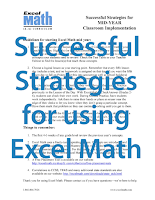
Download our "Successful Strategies for Implementing Excel Math Mid Year" for step-by-step guidelines to begin teaching with Excel Math today. There's no need to wait for summer or fall.

Students can begin preparing for spring testing now.

And you can expect to watch test scores rise when Excel Math is used in either a core or supplement position to complement your existing core math program.

Ring in the New Year with these steps to building student success with math.

Then give us a call to schedule your Professional Development sessions with Bob or Becky. Read more about Excel Math PD for our Standard, Common Core and Texas Editions.

Wednesday, January 6, 2016

Periodic Update: An Elemental Milestone


Memorizing the Periodic Table just got even harder.
On December 30, 2015 the International Union of Pure and Applied Chemistry, a scientific nongovernmental body, formally announced that four new elements will be added to the periodic table, rounding out the seventh row of this well-known chart.

The new elements are all classified as "super-heavy" radioactive substances, meaning they have more than 104 protons. They were created using particle accelerators and, like other super-heavy elements, exist for only a brief moment—as little as a fraction of a second—before decaying.

Periodic Table with Temporary Names for New Elements
The elements are known by temporary names based on the number of protons each contains in its nucleus: ununtrium (element 113), ununpentium (115), ununseptium (117), and ununoctium (118). According to the Union of Pure and Applied Chemistry (IUPAC), "the discoverers from Japan, Russia and the U.S.A. will now be invited to suggest permanent names and symbols."

New elements can be "named after a mythological concept, a mineral, a place or country, a property or a scientist," according to the IUPAC. The proposed names and symbols will be checked by the Inorganic Chemistry Division of IUPAC for consistency, translatability into other languages, possible prior historic use for other cases, etc. 
Then the names and two-letter symbols will be presented for public review for five months, before the highest body of IUPAC, the Council, will make a final decision on the names of these new chemical elements and their two-letter symbols and their introduction into the Periodic Table of the Elements.
Copernicus
This is the first time elements have been added to the table since 2011, reports the Wall Street Journal. The most recent addition to the periodic table was Element 112, formally named copernicium to honor Polish astronomer Nicolaus Copernicus.

Three of the elements—designated with atomic numbers of 115, 117 and 118—were first detected more than a decade ago by researchers at the Joint Institute for Nuclear Research in Russia and the Lawrence Livermore National Laboratory in California. The fourth, with an atomic number of 113, was discovered in 2004 by the Riken research institute in Japan, making it the first element to have been discovered in Asia. Kosuke Morita, who led the research, said his team searched for more than seven years for data to identify the element.


"We just never saw another event," he said. "I was not prepared to give up, however, as I believed that one day, if we persevered, luck would fall upon us again."

And so it did on August 12, 2012, when the group observed the crucial third event. Former Riken president and Nobel Laureate in chemistry Ryoji Noyori told the Guardian: "To scientists, this is of greater value than an Olympic gold medal".

"The chemistry community is eager to see its most cherished table finally being completed down to the seventh row. IUPAC has now initiated the process of formalizing names and symbols for these elements " said Professor Jan Reedijk, the President of the Inorganic Chemistry Division of IUPAC.

Unfortunately, as science teachers know, textbooks often don't keep up with the times. So it could be quite a few years before students see that completed seventh row in their chemistry textbooks.
That's what makes Excel Math so great. Lessons are updated throughout the year so you never have to worry about whether you have the latest materials. Take a look at sample Excel Math lessons for Kindergarten through Sixth grade on our website: www.excelmath.com

Ready to place an order? Visit our web store: https://excelmath.myshopify.com/

You may also enjoy these articles:


Higher Order Word Problems for Math Students

Financial Awareness for Students
  
Calming the Frenzy Over Fractions