Wednesday, May 15, 2013
Spring Bulletin Boards for the Math Class
If April showers bring May flowers, what do May flowers bring? Perhaps colorful new bulletin board sets for your math classroom!
For a clever raindrop bulletin board, cut raindrop shapes from paper or cardboard. Print math facts on the drops and hang them from the ceiling in front of your bulletin board.
Staple an old umbrella half to the bulletin board. Hang additional math fact raindrops from the umbrella. Letter each raindrop and let your students write down the answers during your bell work or when they finish assignments early. Prepare an answer sheet so your students can exchange papers and check their work as they finish. Let your students cut additional raindrops and add their own problems to them so you have an ongoing supply of new math problems to add to the bulletin board each week. Younger students may simply count the number of various colored raindrops hanging from the board.
Download this cute cat with umbrella pattern to include on your bulletin board or as a welcome sign for the door to your classroom (just add the word "Welcome" to the blank space on the poster). Then enlarge this colorful rainbow to add across one of the walls of your room. Or cut two rainbows, glue them together, and hang the finished rainbow from your ceiling. Then teach your students the rainbow song to help them remember the order that colors appear in rainbows.
Read more . . .
New to Excel Math? Visit our sample pages to learn more and see our proven math worksheets.
You might also like:
Create Your Own Math Certificates and Awards
Bulletin Board Ideas for the Math Classroom
Classroom Management Tips
Monday, May 13, 2013
Listen Up! — Keeping Students' Attention
There's nothing more frustrating than students who just won't listen and follow instructions! In every classroom, there seem to be at least one or two. To make matters worse, their selective hearing impairment seems not only contagious but also quite distracting.
How do successful teachers and parents train kids to listen? First, the teacher does not talk over the students. This is much easier said than done. It's extremely hard for us as human beings to simply wait in silence. Especially when we are short on time and patience. But the teacher who wants to train students how to actively listen will simply stand silently waiting for the students to finish talking.
Then the teacher may remind the class that he will always be glad to wait for the talking to stop before beginning the lesson. The teacher goes on to explain that there will be less time for using computers, doing partner work, playing math games (or whatever activity your class enjoys), but he is always glad to wait for everyone's attention.To be even more proactive, Michael Linsin, author of Dream Class, suggests teaching students to stop what they're doing and look at you when you give a certain signal. Read more . . . More than just worksheets, Excel Math lessons include hands-on visuals and manipulatives, stretches (brainteasers), cooperative learning activities, interactive opportunities (including Projectable Lessons) and a new Common Core Edition coming for fall. Our tried and true "original" Excel Math lessons (updated for 2013) will still be available for Texas and other non-Common Core states. You also receive easy-to-teach lessons (to use as a supplement or in a core position), guided practice, Basic Fact Practice, Homework, and regular assessments. Walk through a lesson on our website: www.excelmath.com/tour/tour01.html You might also like: Summer: A Season of Math Learning Classroom Management Tips Excel Math Summer School Samples |
Thursday, May 9, 2013
Summer: A Season of Math Learning
It all adds up — according to some researchers, students who continue their learning over the summer months are much more likely to be successful in their studies when school starts up again in the fall.
School districts nationwide are encouraged to take advantage of time over the summer to offer innovative learning programs for students—including those who are at risk—and help them as well as teachers prepare for the new state standards. Gary Huggins, CEO of the National Summer Learning Association, writes about the benefits of using the summer months wisely in this opinion article. Some of the benefits he highlights include curbing summer learning loss and preventing drops in test scores. Read more at Education Week (premium article access compliments of EdWeek.org)

Excel Math offers support to parents and teachers working to bridge the summer achievement gap with a proven Summer School program for Pre-Kindergarten through Pre-7th Grade. Six weeks of math instructional materials is less than $7.00 per student.
Continue reading . . .
New to Excel Math? Visit our website to learn more and take a look at sample lessons and math worksheets: www.excelmath.com
You might also like:
Summer Math: Bridging the Achievement Gap
Principals Praise Excel Math for Exceptional Student Math Scores
Excel Math Summer School Samples

Excel Math offers support to parents and teachers working to bridge the summer achievement gap with a proven Summer School program for Pre-Kindergarten through Pre-7th Grade. Six weeks of math instructional materials is less than $7.00 per student.
Continue reading . . .
New to Excel Math? Visit our website to learn more and take a look at sample lessons and math worksheets: www.excelmath.com
You might also like:
Summer Math: Bridging the Achievement Gap
Principals Praise Excel Math for Exceptional Student Math Scores
Excel Math Summer School Samples
Sunday, May 5, 2013
Cinco de Mayo Mathematics
In the southwestern region of the United States, May 5 is a day of celebration that includes food, mariachis, street festivals, parades and festivities of all kinds. Cinco de Mayo (the fifth of May) celebrates the Mexican army's victory over France in 1862 at the Battle of Puebla. Contrary to public opinion, it is not Mexican Independence Day, but instead commemorates a victory during the Franco-Mexican War of 1861-1867.
Cinco de Mayo is a relatively minor holiday in Mexico. But here in the United States, it has grown to become a celebration of Mexican culture and heritage, especially in areas such as San Diego, with a large Mexican-American population. So bring the flavor of Cinco de Mayo into your classroom this week. Tell your students about the Battle of Puebla and the Franco-Mexican War.You may want to explain that the Mexican War of Independence was a battle between the people of Mexico and the Spanish colonial authorities that took place several decades earlier. That holiday is celebrated on September 16.

Excel Math gives you the tools you need to help build confident, successful math students. It's even available in English and in Spanish. (See our order form here.)
If you have some interesting ways you bring Mexican traditions into your math class, feel free to share them. Just click on the word "comments" below.
Read more . . .
You might also like these articles:
Thank You, Teachers!
May Day Math
Seven Steps to Successful Math Students (& Parents)
Happy Birthday, Library of Congress
April: Math Awareness Month
Wednesday, May 1, 2013
May Day Math
Happy May Day! May is Teacher Appreciation Month, which gives us another chance to let you know how much you're appreciated. At Excel Math, we are very thankful for teachers such as you, who go the extra mile for their students. On behalf of the entire Excel Math team, thanks for helping students achieve beyond expectation and for hanging in there even when the going gets tough!
Excel Math gives you the tools you need to help build confident, successful math students. More than just worksheets, Excel Math lessons include hands-on visuals and manipulatives, stretches (brainteasers), cooperative learning activities, interactive opportunities (including Projectable Lessons) and a new Common Core Edition coming for fall. You also receive easy-to-teach lessons (to use as a supplement or in a core position), guided practice, basic Fact Practice, Homework, and regular assessments. Walk through a lesson on our website: www.excelmath.com/tour/tour01.html
At Excel Math, we appreciate teachers! That's why we provide lots of free teacher helps and resources on our website. And it's why we continually update our math lessons to provide teachers with the best materials possible. This certificate is a small token of our appreciation for your perseverance and enthusiasm for your students. Feel free to print it for yourself (just add your name on the blank line) or pass it on to a deserving colleague. For student certificates and awards, visit our website: www.excelmath.com/downloads.html

Now that we're beginning the month of May, plan a May Day celebration for your students with some math thrown in for good measure. Talk about the shapes of various objects around your classroom. Point out a cone, cylinder, sphere, cube, and other shapes your students can identify.
Explain that in honor of the month of May, everyone will make a cone shape and then turn it into a May basket. Give each student a colorful sheet of heavy paper or cardboard. Let him roll it into a cone shape. Provide scissors to trim the top of the cone opening. Tape the cone together. Let the student punch a hole on each side of the cone, then string a chenille wire handle through the holes, bending it slightly to form a handle. (Or download a May basket pattern from Scholastic.com.)
You can have each student measure the diameter of the cone opening and then calculate the radius by dividing the diameter in half. Let the students work in pairs to check their work.
If you have time, let your students make tissue paper flowers to put in the cone basket. Give the students each a half piece of paper on which to write a cheery spring greeting or decorate a card for a family member or friend. Encourage each student to leave a flower basket on their friend's doorknob (without being noticed, if possible).
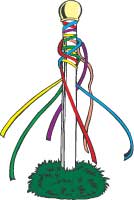
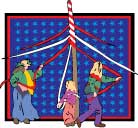
While the students work, talk about May Day traditions and the May Pole. May Day is historically a joyful and festive time of dancing, singing and bright decorations. Wrapping a May pole with colorful ribbons as people dance around the pole is one of the ways people have celebrated for centuries. Some towns in England and Scotland take a holiday on May Day and hold town fairs complete with parades where children carry beautiful garlands of flowers. Read more about May Day at the Edina Historical Society blog.
Are you planning any special May celebrations in your classroom? Share one that your students enjoy by leaving a comment in the box below. (Click on the word comment.)
New to Excel Math? Visit our website to learn more and take a look at sample lessons: www.excelmath.com
Excel Math gives you the tools you need to help build confident, successful math students. More than just worksheets, Excel Math lessons include hands-on visuals and manipulatives, stretches (brainteasers), cooperative learning activities, interactive opportunities (including Projectable Lessons) and a new Common Core Edition coming for fall. You also receive easy-to-teach lessons (to use as a supplement or in a core position), guided practice, basic Fact Practice, Homework, and regular assessments. Walk through a lesson on our website: www.excelmath.com/tour/tour01.html
![]() |
| Click here to download the award |
Now that we're beginning the month of May, plan a May Day celebration for your students with some math thrown in for good measure. Talk about the shapes of various objects around your classroom. Point out a cone, cylinder, sphere, cube, and other shapes your students can identify.Explain that in honor of the month of May, everyone will make a cone shape and then turn it into a May basket. Give each student a colorful sheet of heavy paper or cardboard. Let him roll it into a cone shape. Provide scissors to trim the top of the cone opening. Tape the cone together. Let the student punch a hole on each side of the cone, then string a chenille wire handle through the holes, bending it slightly to form a handle. (Or download a May basket pattern from Scholastic.com.)

You can have each student measure the diameter of the cone opening and then calculate the radius by dividing the diameter in half. Let the students work in pairs to check their work.
If you have time, let your students make tissue paper flowers to put in the cone basket. Give the students each a half piece of paper on which to write a cheery spring greeting or decorate a card for a family member or friend. Encourage each student to leave a flower basket on their friend's doorknob (without being noticed, if possible).
While the students work, talk about May Day traditions and the May Pole. May Day is historically a joyful and festive time of dancing, singing and bright decorations. Wrapping a May pole with colorful ribbons as people dance around the pole is one of the ways people have celebrated for centuries. Some towns in England and Scotland take a holiday on May Day and hold town fairs complete with parades where children carry beautiful garlands of flowers. Read more about May Day at the Edina Historical Society blog.

Are you planning any special May celebrations in your classroom? Share one that your students enjoy by leaving a comment in the box below. (Click on the word comment.)
New to Excel Math? Visit our website to learn more and take a look at sample lessons: www.excelmath.com
Monday, April 29, 2013
Poetry for the Math Class
Since April is National Poetry Month, we thought it would be fun to dig up some math-related poetry you can use with your students all year.
To help your class see how mathematics is an integral part of everyday life (and to show your students that you can empathize with those who may be struggling with math), read aloud the poem Arithmetic by Carl Sandburg. Here are few lines:
Excel Math lessons help students relate math to everyday life. Students become confident in mathematics as they progress through the Excel Math system and are better prepared for higher-order thinking skills and advanced math education. In fact, many students develop a love for math! Take a look at our proven lessons for Kindergarten through Grade 6 at www.excelmath.com. More than just worksheets, these lessons really work!
Today and tomorrow, the national finals of the annual Poetry Out Loud contest are being held at George Washington University. Created by the National Endowment for the Arts and the Poetry Foundation, Poetry Out Loud brings together students from all 50 states, the District of Columbia, the U.S. Virgin Islands, and Puerto Rico. Over 375,00 students representing more than 2,000 schools compete in poetry recitation competitions all year long. The top 50 or so finalists travel to Washington D. C. to compete for the top poetry-recitation honors (and these poems have to be memorized). The finals are broadcast only as they occur, so you may want to organize a viewing party. You can watch the live webcast at www.arts.gov. Read more . . .
You may want to read to your class one or two of these clever poems listed on the Poetry Foundation website:
Or this classic from Walt Whitman:
To help your class see how mathematics is an integral part of everyday life (and to show your students that you can empathize with those who may be struggling with math), read aloud the poem Arithmetic by Carl Sandburg. Here are few lines:
Arithmetic
Arithmetic is where numbers fly like pigeons in and out of your
head . . .
Arithmetic is numbers you squeeze from your head to your hand
to your pencil to your paper till you get the answer.
Arithmetic is where the answer is right and everything is nice and
you can look out of the window and see the blue sky — or the
answer is wrong and you have to start all over and try again
and see how it comes out this time.
If you take a number and double it and double it again and thenRead the rest of the poem at AllPoetry.com. You may want to have your students write their own poems about their love of or struggles with math. Or have them write about how they use math each day of their lives (even when not at school).
double it a few more times, the number gets bigger and bigger
and goes higher and higher and only arithmetic can tell you
what the number is when you decide to quit doubling.
Excel Math lessons help students relate math to everyday life. Students become confident in mathematics as they progress through the Excel Math system and are better prepared for higher-order thinking skills and advanced math education. In fact, many students develop a love for math! Take a look at our proven lessons for Kindergarten through Grade 6 at www.excelmath.com. More than just worksheets, these lessons really work!
Today and tomorrow, the national finals of the annual Poetry Out Loud contest are being held at George Washington University. Created by the National Endowment for the Arts and the Poetry Foundation, Poetry Out Loud brings together students from all 50 states, the District of Columbia, the U.S. Virgin Islands, and Puerto Rico. Over 375,00 students representing more than 2,000 schools compete in poetry recitation competitions all year long. The top 50 or so finalists travel to Washington D. C. to compete for the top poetry-recitation honors (and these poems have to be memorized). The finals are broadcast only as they occur, so you may want to organize a viewing party. You can watch the live webcast at www.arts.gov. Read more . . .
You may want to read to your class one or two of these clever poems listed on the Poetry Foundation website:
A Teacher’s Lament by Kalli Dakos
Mrs. Stein by Bill Dodds
The Creature in the Classroom by Jack Prelutsky
Freddie by Phil Bolsta
An Equation for My Children by Wilmer Mills
Prof of Profs by Geoffrey Brock
Or this classic from Walt Whitman:
I Hear America Singing
I hear America singing, the varied carols I hear,
Those of mechanics, each one singing his as it should be blithe and strong,
The carpenter singing his as he measures his plank or beam,
The mason singing his as he makes ready for work, or leaves off work,
The boatman singing what belongs to him in his boat, the deckhand singing on the steamboat deck,
The shoemaker singing as he sits on his bench, the hatter singing as he stands,
The wood-cutter’s song, the ploughboy’s on his way in the morning, or at noon intermission or at sundown,
The delicious singing of the mother, or of the young wife at work, or of the girl sewing or washing,
Each singing what belongs to him or her and to none else,
The day what belongs to the day—at night the party of young fellows, robust, friendly,
Singing with open mouths their strong melodious songs.
The Poetry Out Loud competition has an online list of those poems eligible for the 2012-2013 Poetry Out Loud competition. This list is a great poetry resource, searchable alphabetically or by author.
Let us know how you incorporate poetry in your classes. Share a comment in the box below and tell us the grade level(s) you teach.
Excel Math lessons for Kindergarten through Grade 6 help build confident, successful math students. Learn more and take a look at samples at www.excelmath.com. Read the glowing reports from administrators, teachers and parents: http://excelmath.com/about/successes.html.
Those of mechanics, each one singing his as it should be blithe and strong,
The carpenter singing his as he measures his plank or beam,
The mason singing his as he makes ready for work, or leaves off work,
The boatman singing what belongs to him in his boat, the deckhand singing on the steamboat deck,
The shoemaker singing as he sits on his bench, the hatter singing as he stands,
The wood-cutter’s song, the ploughboy’s on his way in the morning, or at noon intermission or at sundown,
The delicious singing of the mother, or of the young wife at work, or of the girl sewing or washing,
Each singing what belongs to him or her and to none else,
The day what belongs to the day—at night the party of young fellows, robust, friendly,
Singing with open mouths their strong melodious songs.
The Poetry Out Loud competition has an online list of those poems eligible for the 2012-2013 Poetry Out Loud competition. This list is a great poetry resource, searchable alphabetically or by author.
Let us know how you incorporate poetry in your classes. Share a comment in the box below and tell us the grade level(s) you teach.
Excel Math lessons for Kindergarten through Grade 6 help build confident, successful math students. Learn more and take a look at samples at www.excelmath.com. Read the glowing reports from administrators, teachers and parents: http://excelmath.com/about/successes.html.
Subscribe to:
Posts (Atom)


